
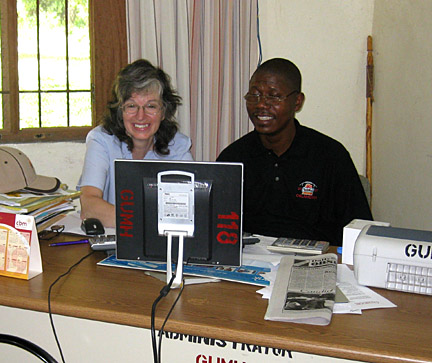
Janice Flahiff and Victor Taylor, an administrator at Ganta Nursing School, checked out Web sites.
Thirty years ago, I left Liberia after two satisfying years of Peace Corps service teaching math and science in a rural junior high school. This past May, I returned for three and a half weeks to again share knowledge as well as learn more about Liberia firsthand. This time I traveled with a group sponsored by the Friends of Liberia, a nonprofit organization that is largely made of “returned” (this word is used instead of former!) Peace Corps volunteers from across the United States. Our group of 27 was divided into three teams: health/medical, teacher training and environmental. I was the sole medical librarian with nine other team members, including a physician, several nurses, mental health professionals, social workers and a laboratory technologist.
Our team worked at two different up-country mission hospitals for a week each as guest lecturers in their nursing programs as well as consultants to the faculty and staff. My goal was to teach basic computer skills and how to find free, relevant, reputable health/medical Web sites. The hospitals have Internet connections via satellite. However, electricity is only available for about nine hours each day at both hospitals. Fuel costs for the generators are high, and publicly available electricity is limited to about 10 square blocks in the capital. Before traveling to Liberia, I collected more than 100 Web sites and posted them at http://delicious.com/GantaHospital and http://delicious.com/CurranHospital. I was hoping to refine them after consulting with faculty and staff at both sites.
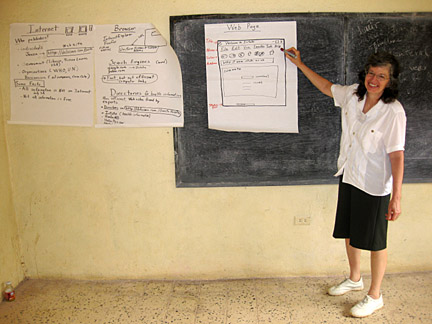
Janice Flahiff taught an Internet workshop for Ganta Nursing School faculty.
Ganta Hospital had two computers in a small room, which could seat about six people, and no means to present the Internet live or through screen shots in a classroom. I presented an hour-and-half lecture to a nursing class of 30 students and separately to a group of seven faculty. I focused on the rudiments of searching, Web-site evaluation and Web-based health/medical information directories. Most of the students seemed alert and interested, and took notes.
At a second session, a nursing instructor approached me at the start of class and tactfully proposed that I use his laptop so that students in groups of five could view the basics of Internet searching. I showed them the “delicious” sites I set up and a Web directory, stressing Web evaluation, links and Web-page navigation. Many were able to apply what they had learned in lecture and were extremely interested in the Web-page content, especially disease information. They read as much as they could before their 10 minutes were up. The Internet connection was a bit slow, but workable.
Curran Hospital had a library about the size of a reading room, with seven PCs. The Internet connection at this site was very similar to what I experience at work. I taught content similar to that at Ganta Hospital to two interested faculty members: a Peace Corps education volunteer on site who showed interest, and the hospital’s librarian, who had recently completed a three-month library certificate in the country. One faculty member was having challenges with using a mouse, while the other faculty member seemed adept at navigating within a Web page. I was seated between them and did the best I could striking a balance between their learning levels. The Peace Corps volunteer asked for another meeting. I was happy to oblige, and we went over questions she had, basically about good Web sites for specific classes the students were taking.
The level and length of training at both sites were limited, probably because of a number of factors. Teaching schedules by members of our group were not made until on site and were entirely at the discretion of the hospital administration. Faculty, staff and students spend long days at the hospitals, so Internet sessions were worked in not only with their existing schedules, but classes conducted by other members of the health/medical team.
While the contact time for formal and informal teaching probably could not have been made longer, a few things probably would have made the experience more relevant for the staff and students. I could have made e-mail contact with hospital administrators ahead of time and gauged expectations and Internet knowledge and experience among the students and staff. Most staff and many students seemed to own cell phones. Not only could I have “advertised” office hours, I could have made myself available for consultations by providing my cell phone number. That being said, those who were able to attend the presentations were given basic information on the Internet and hopefully a good starting point for relevant Web sites.
Flahiff is a reference librarian in Mulford Library.